How Much Does an AI Agent Cost? 2025 Pricing
An AI agent costs a small business roughly $20–$500 per month for an off-the-shelf SaaS tool, about $1–$4 per resolved conversation for pay-per-outcome customer support agents, or a custom build priced to your scope — a one-time build fee plus a monthly amount to run it — when an agency builds it on your own data and systems. Your real number depends on volume, integrations, and how much you customize.
Most pricing guides stop at those headline ranges. They skip the costs that actually decide whether an AI agent pays off for a small or mid-sized business: the token bills, the maintenance, and the break-even math. Below is the full picture, tier by tier.
What are the real cost tiers for an AI agent?
There are three ways to buy, and they price very differently:
| Tier | What it is | Typical price | Best for |
|---|---|---|---|
| 1. Off-the-shelf SaaS (Buy) | Subscribe to a pre-built platform, configure it yourself | ~$20–$500+/mo per seat | Simple chat, scheduling, FAQ deflection |
| 2. Pay-per-outcome | You pay only when the agent resolves a ticket/conversation | ~$1–$4 per resolution | Customer support with variable volume |
| 3. Custom agency build | A partner builds an agent on your data and systems | Upfront build fee + monthly ops | Deep integrations, brand-specific workflows |
The SaaS and pay-per-outcome ranges above reflect the current market summary in Google's AI Overview; confirm exact figures against live vendor pricing before you budget.
The cheapest tier is not always the cheapest outcome. A $99/month tool that can't connect to your booking system may cost you more in missed appointments than a custom agent that can.
Who are the "big 4" AI agents?
When people search for the "big 4," they usually mean the major general-purpose assistant/agent platforms from the largest AI labs — commonly OpenAI (ChatGPT / Agent Builder), Google (Gemini), Anthropic (Claude), and Microsoft (Copilot). These are foundation-model platforms, not turnkey business agents. You still need to configure, connect, and often build on top of them. For a small business, the practical question isn't which of the four is "best" — it's which one your agency or no-code builder uses under the hood.
Can you buy an AI agent, and is any AI agent free?
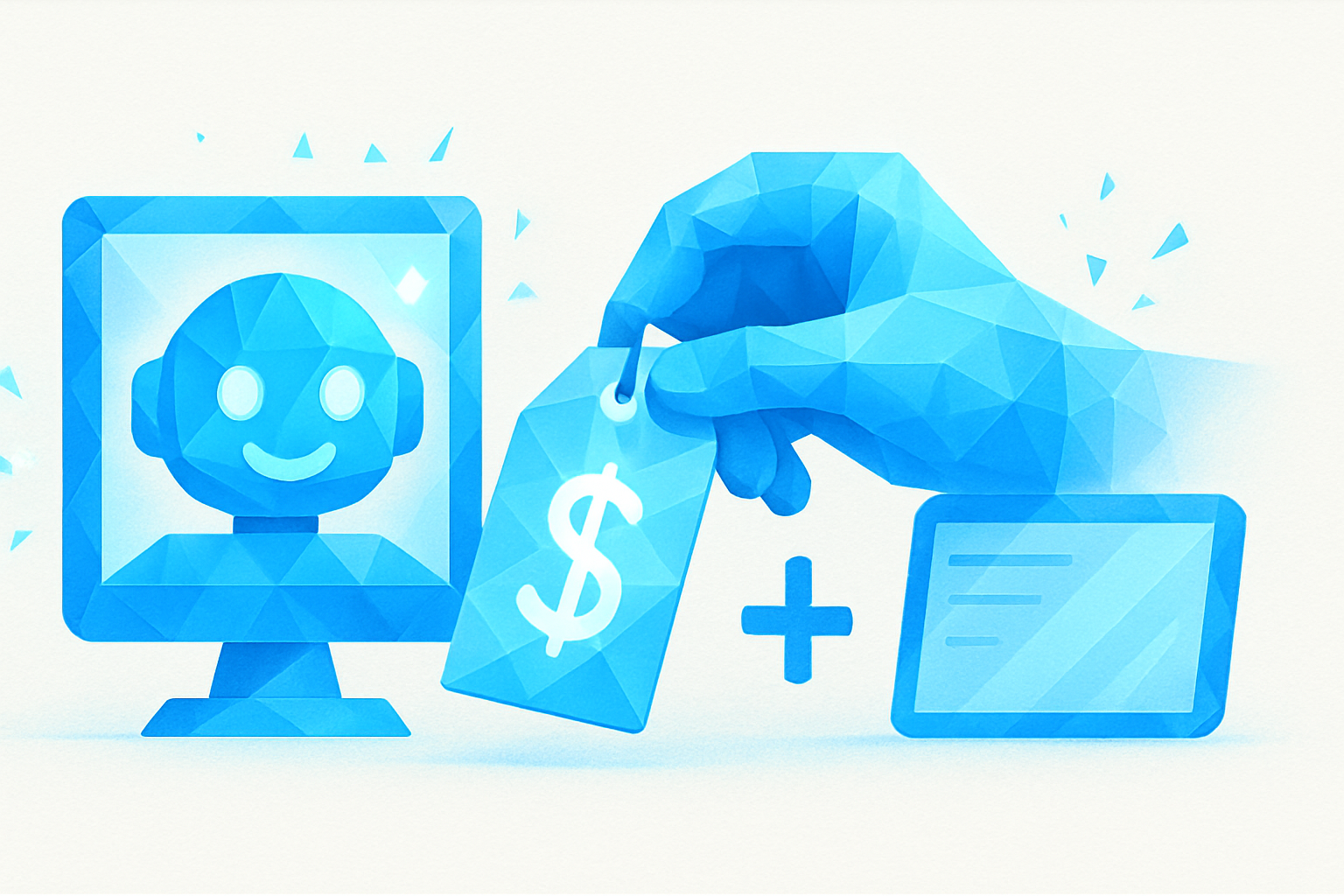
Yes — you can buy an AI agent as a subscription today, and several have free tiers. Free plans (and free chatbot builders) exist, but they typically cap message volume, limit integrations, and put the vendor's branding on your customer experience. They're fine for testing. They rarely handle real business volume without upgrading. "Free" also never covers the model usage costs once you scale — someone pays the API bill.
What does it actually cost to run an AI agent (token & API costs)?
This is the line item most guides omit. When your agent "thinks," it calls a large language model, and you pay per token (roughly per word). A customer conversation might use a few thousand tokens across the back-and-forth plus retrieved context.
Current published API rates from OpenAI (openai.com/pricing) and Anthropic (anthropic.com/pricing) are the source of truth here — they change often, so pull them live. As a planning rule of thumb: heavier models like GPT-4-class or Claude Sonnet-class cost more per conversation than smaller/mini models, and long retrieved documents inflate every call. Estimate your monthly conversations, multiply by your average tokens per conversation, and price it against current rates rather than trusting a static number.
What are the hidden maintenance costs?
A custom AI agent is software — it needs upkeep. Budget for these, because they're what turn a "cheap" build into an ongoing line item:
- Vector database hosting — tools like Pinecone or Qdrant store your knowledge base so the agent can retrieve answers. This is a recurring hosting cost that scales with your data.
- RAG retrieval updates — when your prices, policies, or menu change, someone has to re-index the source documents so the agent stops quoting stale answers.
- Prompt recalibration — as models update and edge cases surface, the instructions guiding the agent need tuning.
- Monitoring & escalation — reviewing conversations the agent handled poorly and routing them to a human.
The no-code path hides some of this inside the subscription; the custom path exposes it as your responsibility (or your agency's retainer).
No-code builders vs. custom agency build: which costs less?
| Factor | No-code (Voiceflow, Make, Zapier) | Custom agency build |
|---|---|---|
| Upfront cost | Low (subscription) | Higher (project fee) |
| Time to launch | Days to weeks | Weeks to months |
| Deep integrations | Limited by connectors | Whatever you can code |
| Ongoing cost | Predictable subscription | API + hosting + retainer |
| Ownership | You rent the platform | You own the system |
For many Nashville small businesses, a no-code agent is the right first step — it's fast and cheap to validate. You graduate to a custom build when the platform's limits start costing you customers or when you need it wired into tools a connector can't reach.
Can you really make money with AI agents? The ROI math
The honest answer: it depends on what the agent replaces or frees up, not on the tool itself. Here's the framework we use with clients — plug in your own numbers:
- Cost of the task today — e.g., hours a staffer or answering service spends on repetitive inquiries.
- Cost of the agent — subscription (or build amortized over ~24 months) + monthly token/hosting/maintenance.
- Coverage — what share of that volume the agent can reliably handle without a human.
- Break-even — the month where cumulative savings exceed cumulative agent cost.
An AI receptionist that answers after-hours calls, for instance, is competing against the cost of a live answering service or missed bookings — not against a full salary. When you price an "AI receptionist," price it against what you're actually paying now for that coverage, then decide.
We don't promise a specific return — anyone who does is guessing. We do help you build the model with real numbers so the decision is grounded before you spend.
The bottom line
SMB budgets in 2025 land in three brackets: a subscription in the low hundreds per month, pay-per-outcome pricing that scales with support volume, or a custom build with an upfront fee plus monthly running costs. The deciding costs are the ones under the headline — tokens, hosting, and maintenance — and the deciding question is what the agent replaces. Model both before you buy.
Frequently asked
- How much does an AI agent cost per month?
- Off-the-shelf SaaS AI agents commonly run about $20–$500+ per month per seat, per the current market summary. Custom agents add monthly running costs (LLM API usage, vector database hosting, and maintenance) on top of an upfront build fee. Confirm exact figures against live vendor pricing before budgeting.
- How much does an AI agent cost per hour or per day?
- AI agents usually aren't priced by the hour or day — they're priced by subscription seat, per resolved conversation (roughly $1–$4 per resolution for support agents), or by usage (tokens). If a vendor quotes hourly, it's typically consulting or setup labor, not the agent's runtime.
- Is any AI agent free?
- Yes — several platforms offer free tiers, and free chatbot builders exist. Free plans cap message volume, limit integrations, and often show vendor branding. They're good for testing but rarely handle real business volume, and they don't cover the model API costs once you scale.
- How much should I charge for an AI receptionist?
- Price it against what you pay now for that coverage — a live answering service or the cost of missed after-hours bookings — not against a full salary. Add up the agent's subscription or amortized build cost plus monthly token, hosting, and maintenance, then set pricing above your true delivery cost.
- Can you really make money with AI agents?
- An AI agent can save money or free up staff time when it reliably handles repetitive volume you currently pay for. Whether it nets a return depends on your task cost, the agent's cost, and how much it covers — build the break-even math with real numbers before committing. No honest partner guarantees a specific return.

Written by
Ryan Hood
Founder, Akira Web Solutions
Founder of Akira Web Solutions, the Nashville company building custom AI systems for small businesses.
More about Akira →