What Is an AI Agent? Plain-English Guide for SMBs
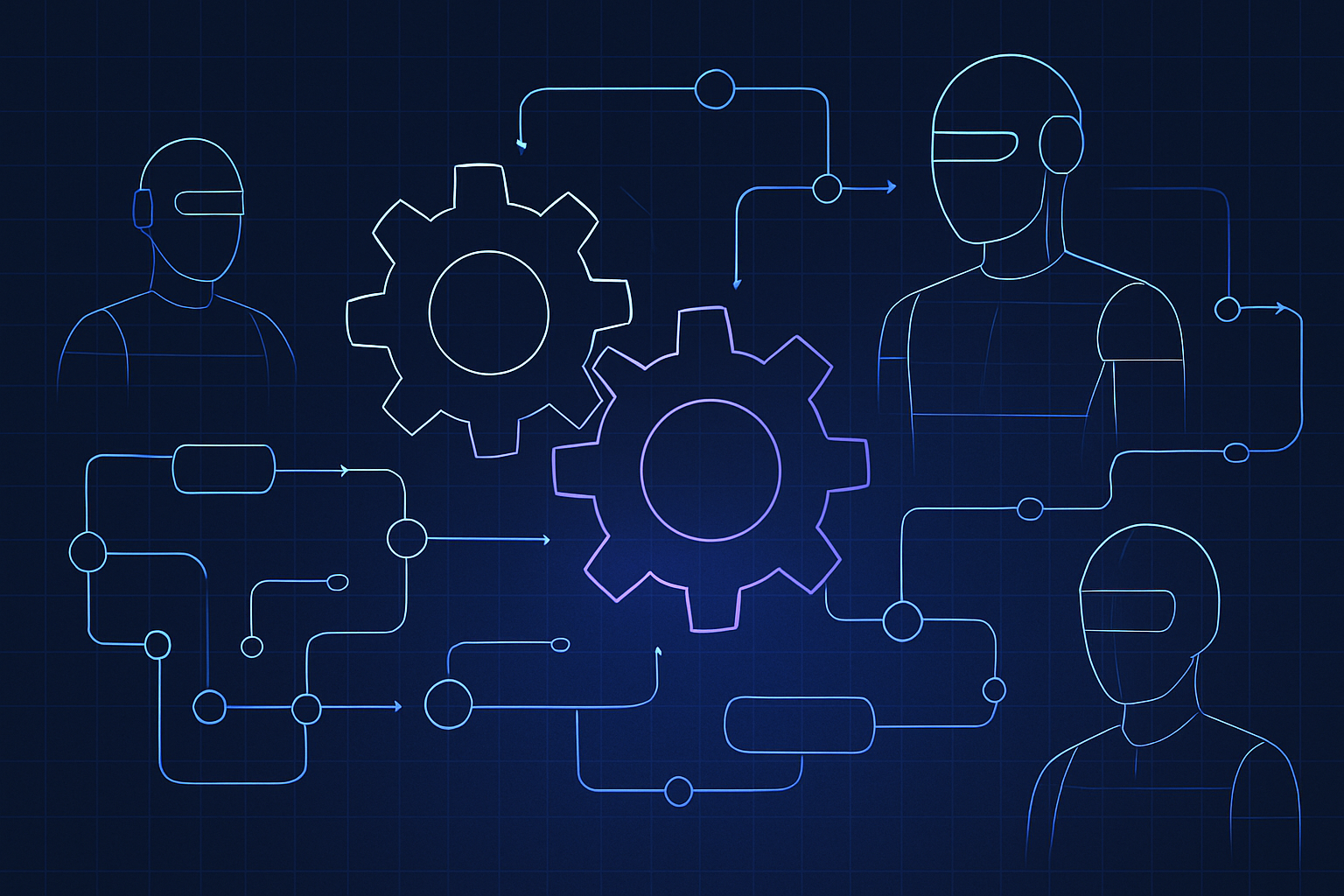
An AI agent is autonomous software—usually powered by a large language model (LLM)—that reads its situation, makes a plan, and takes multiple steps using outside tools (your calendar, CRM, email, payment system) to reach a goal, without a human approving every step. Unlike a chatbot that answers one question at a time, an agent does the task.
That's the working definition major vendors now use (IBM, Google Cloud, Anthropic). Below is what it means for an owner deciding where to actually put one—and where not to.
What is an AI agent in layman's terms?
A chatbot is a smart FAQ: you ask, it replies, it stops. An AI agent is a smart assistant with hands. Tell it "rebook the customer who canceled tomorrow's 2pm," and it reads the calendar, finds an open slot, texts the customer options, updates the booking, and logs the change in your CRM—checking in only when it's unsure. The LLM is the "brain" that reasons and breaks the goal into steps; the tools (connections to your software) are the "hands" that execute. That loop—perceive, plan, act, observe, repeat—is what separates an agent from a chatbot.
Is ChatGPT an AI agent?
By itself, standard ChatGPT is closer to a chatbot: it responds to prompts. It becomes agent-like when given tools and autonomy—for example a Custom GPT or an OpenAI Assistant with function calling that can browse, run code, or reach your systems, or OpenAI's newer agent/operator features that take multi-step actions on the web. The same applies to Microsoft Copilot Studio agents, Google Gemini with Vertex AI, and Anthropic's Claude with tool use and the Model Context Protocol (MCP) for connecting to your data. Rule of thumb: if it only talks, it's a chatbot; if it takes actions across tools to finish a job, it's an agent.
What is an example of an AI agent? (Real SMB workflows)
The honest small-business answer isn't self-driving cars—it's boring, repeatable back-office work. Agents are most reliable on structured, rules-based tasks:
- Automated appointment rebooking — detects a cancellation, offers new times by text, updates the calendar.
- Two-way lead qualification — replies to a web form or missed call, asks 3–4 qualifying questions, books the qualified ones and tags the rest.
- CRM enrichment — after a call or email, summarizes it, fills contact fields, and sets the next follow-up.
- Review & inbox triage — drafts responses to reviews and routine emails for a human to approve.
- Order/status lookups — pulls status from your system and answers "where's my order?" instantly.
For a Nashville med-spa, HVAC company, or law office, that's hours a week of admin—handled around the clock. The point isn't flash; it's reclaiming staff time from repetitive tasks so people can do the work that actually needs a person.
What can't an AI agent automate?
This is the section most articles skip. Agents fail—sometimes expensively—on judgment, ambiguity, and edge cases. Know the limits:
- Hallucination in customer service. An LLM can state a policy, price, or promise that doesn't exist. On refunds, warranties, or legal/medical questions, that's brand and liability risk. (A widely reported 2024 tribunal case found Air Canada liable for a refund policy its support chatbot invented—confirm the specifics before citing.)
- Edge-case and exception handling. "My situation is unusual" is exactly where agents guess wrong.
- High-stakes or irreversible actions. Issuing refunds, sending contracts, charging cards, deleting records.
- Emotion and de-escalation. An upset customer needs a human, not a confident bot.
The fix isn't avoiding agents—it's guardrails: restrict what tools the agent can touch, give it an approved knowledge base instead of open-ended answers, cap dollar amounts, and require human sign-off on anything irreversible.
Where does a human stay in the loop?
Human-in-the-loop (HITL) means the agent does the work but a person approves the risky step. A practical pattern:
| Task | Agent does | Human approves before it happens? |
|---|---|---|
| Draft review/email reply | Writes it | Yes—one-click send |
| Book a standard appointment | Books it | No (low risk) |
| Issue a refund | Prepares it | Yes—always |
| Answer a policy question | Answers from approved docs | No, if in scope; escalates if not |
| Send a quote/contract | Drafts it | Yes—always |
Start with "draft-and-approve" for everything, then remove the human only from the low-risk, high-volume steps that prove reliable.
What does an AI agent cost for a small business?
You don't need enterprise frameworks. The stack splits roughly two ways:
- Low-code / accessible (best for most SMBs): Zapier Agents, Make, and Custom OpenAI Assistants let you wire an agent to your existing tools without a developer. Faster to launch, easier to maintain.
- Developer frameworks (custom/complex needs): LangGraph, LlamaIndex, Microsoft AutoGen, and CrewAI give full control for multi-agent or specialized workflows—but need engineering.
Ongoing cost is mostly LLM API usage (billed per token) plus platform or subscription fees, which vary by volume and vendor and change often. We don't publish fixed pricing here because it depends on your task volume—confirm current rates directly with each vendor.
Who are the "big" AI agent platforms, and what about AI agent salaries?
There's no official "big four," but the major platforms SMBs encounter are OpenAI, Google (Gemini/Vertex AI), Microsoft (Copilot), and Anthropic (Claude), with AWS Bedrock common on the infrastructure side. On "AI agent salary": that search usually means the pay for humans who build agents (AI/ML engineers)—not the software—and figures vary widely by market and source, so verify against current salary data rather than a single number.
The takeaway for owners
An AI agent earns its place when the task is repetitive, rules-based, and high-volume—and when you keep a human on anything irreversible. Start narrow, add guardrails, prove reliability, then expand. That's how you get the time savings without the brand risk.
Not sure which of your workflows are safe to automate first? Akira Web Solutions maps your busywork against the guardrail framework above and helps you launch a narrow, human-in-the-loop agent you can trust. Book a workflow audit with our team and we'll show you exactly where an agent fits—and where it shouldn't.
Frequently asked
- Is ChatGPT an AI agent?
- Standard ChatGPT is essentially a chatbot—it responds to prompts. It becomes an agent when given tools and autonomy (function calling, browsing, or connections to your systems), such as an OpenAI Assistant or Custom GPT that can take multi-step actions to complete a task.
- What is an example of an AI agent for a small business?
- Common reliable examples include automated appointment rebooking, two-way lead qualification from web forms or missed calls, CRM enrichment after calls, order-status lookups, and drafting review or email replies for a human to approve.
- What can't an AI agent automate?
- Judgment calls, ambiguous edge cases, emotional de-escalation, and high-stakes or irreversible actions like refunds, contracts, or charges. These carry hallucination and liability risk, so keep a human approval step on anything that can't be undone.
- Do I need LangChain or a developer to build an agent?
- Not usually. Most small businesses can start with low-code tools like Zapier Agents, Make, or Custom OpenAI Assistants. Developer frameworks like LangGraph or Microsoft AutoGen are for custom or multi-agent workflows that need engineering.
- What is human-in-the-loop (HITL)?
- HITL means the agent does the work but a staff member approves the risky step before it executes. A good starting rule: draft-and-approve everything, then remove the human only from low-risk, high-volume tasks that prove reliable.

Written by
Ryan Hood
Founder, Akira Web Solutions
Founder of Akira Web Solutions, the Nashville company building custom AI systems for small businesses.
More about Akira →